Know what electricity costs.
The average spot electricity price in Finland in September 2026 was 5,70 c/kWh excluding VAT (7,15 c/kWh with 25,5 % VAT). The 2025 average was 4,05 c/kWh, but in winter 2026 the February average rose to 13,72 c/kWh. Electricity tax rose to 2,325 c/kWh from 1.4.2026, and Fingrid estimates winter peak consumption at about 15 200 MW.
Electricity Price Radar brings together spot electricity prices, the components of an electricity bill and typical consumption. With the calculator you can see what your own consumption costs at different prices.
- Households and electric heating users
- Small businesses and housing companies
What does electricity cost now?
Finland's spot electricity prices today and tomorrow. Tomorrow's prices are published in the afternoon at around 14.00
Fetching prices…
cheap mid-level expensive · line = now
How much does this cost now?
Distribution default: Energy Authority 15.1.2026, typical household (incl. VAT). Replace it with your own network company's price from your electricity bill.
Prices as a table
| Hour | c/kWh |
|---|
Compare electricity contracts
All electricity contracts available for your postcode (Energy Authority, Sähkönhinta.fi) from cheapest to most expensive according to your annual consumption.
| Contract | Template | Energy c/kWh | Basic fee €/month | Per year |
|---|
Annual cost = base fee × 12 + consumption × energy price. In spot contracts, energy price = assumed spot price + margin; in time-of-use electricity daytime 65% / night 35%, in seasonal electricity winter daytime 30% / other 70%. Campaign discounts are not included in the calculation. The transmission fee and electricity tax are paid to the network company regardless of the contract. Check the terms with the seller before ordering.
Source: Nord Pool day-ahead prices, Finland bidding zone. The hourly price is the average of the quarter-hour prices. Your contract's margin and transmission fee are added on top.
Calculator
Calculator
Calculators on their own pages: Electricity calculator · Company electricity cost calculator (VAT 0 %) · Electricity calculator · Electrical appliance consumption calculator · Air-source heat pump savings calculator and payback time · Solar panel calculator · All calculators
Electricity Price Radar in numbers
Monthly average spot electricity prices in Finland, last 12 months
Monthly averages for the Finnish price area of Nord Pool's day-ahead market. The price including VAT is calculated by multiplying the VAT 0 price by 1.255. The price does not include the seller's margin, basic fee, transmission or electricity tax.
| Month | €/MWh (VAT 0) | c/kWh (VAT 0) | c/kWh (incl. VAT 25,5 %) |
|---|---|---|---|
| October 2025 | 48,94 | 4,89 | 6,14 |
| November 2025 | 47,94 | 4,79 | 6,02 |
| December 2025 | 36,01 | 3,60 | 4,52 |
| January 2026 | 117,27 | 11,73 | 14,72 |
| February 2026 | 137,16 | 13,72 | 17,21 |
| March 2026 | 27,79 | 2,78 | 3,49 |
| April 2026 | 49,46 | 4,95 | 6,21 |
| May 2026 | 52,93 | 5,29 | 6,64 |
| June 2026 | 45,27 | 4,53 | 5,68 |
| July 2026 | 15,37 | 1,54 | 1,93 |
| August 2026 | 41,30 | 4,13 | 5,18 |
| September 2026 | 56,98 | 5,70 | 7,15 |
Typical annual consumption by housing type
Typical electricity consumers used in the price statistics of Statistics Finland and the Energy Authority, and Motiva's two example households. Actual consumption varies with the number of residents, the heating method and appliances.
| Form of housing | Annual consumption | Additional information |
|---|---|---|
| Block of flats, no electric sauna heater (typical user K1) | 2 000 kWh | Main fuse 1x25 A |
| Detached house, electric sauna stove, no electric heating (K2) | 5,000 kWh | Main fuse 3x25 A |
| Detached house, direct electric heating (L1) | 18 000 kWh | Main fuse 3x25 A |
| Detached house, partial storage electric heating (L2) | 20 000 kWh | Main fuse 3x25 A |
| Agriculture, no electric heating (M1) | 10 000 kWh | Main fuse 3x35 A |
| Agriculture, livestock farming, direct electric heating (M2) | 35,000 kWh | Main fuse 3x35 A |
| Motiva's example: apartment block flat 50 m², district heating, 1 resident | 3 100 kWh | Motiva 2024 |
| Motiva's example: detached house 120 m², electric heating, 4 residents | 18 900 kWh | Of which heating 9,500 kWh, Motiva 2024 |
| Charging an electric car (Motiva's example) | 2 400 kWh | Increase in household consumption, Motiva 2024 |
What an electricity bill consists of
An electricity bill is divided into electrical energy charged by the electricity supplier and the network service (transmission) charged by the network company, which includes electricity tax. Average prices at 1.11.2025 prices according to the Energy Authority; tax data from the Tax Administration.
| Invoice item | What it is | Figure |
|---|---|---|
| Electrical energy | The electricity supplier's energy charge (c/kWh) and basic fee (€/month); can be put out to tender | 9.45 c/kWh household 5,000 kWh/year; 7.94 c/kWh electric heating 18,000 kWh/year (incl. VAT, 1.11.2025) |
| Electricity transmission (network service) | The local network company's basic fee and transmission fee; cannot be put out to tender | 11,41 c/kWh household; 7,61 c/kWh electric heating (incl. VAT and electricity taxes, 1.11.2025) |
| Electricity tax, tax class I | Excise duty invoiced by the network company together with transmission | 2,24 c/kWh + security of supply fee 0,085 c/kWh = 2,325 c/kWh (VAT 0, from 1.4.2026) |
| Electricity tax before 1.4.2026 | Reference data | 2,253 c/kWh (VAT 0, 1.1.2023–31.3.2026) |
| Value added tax | Added to both energy and transmission | 25,5 % (from 1.9.2024) |
| Total price | Energy, transmission and taxes combined | 20,86 c/kWh household; 15,55 c/kWh electric heating (1.11.2025) |
| Total annual bill | Calculated with a typical user's annual consumption | 1 043 € household 5 000 kWh; 2 800 € electrically heated home 18 000 kWh (at 1.11.2025 prices) |
How much does everyday electricity use cost?
Typical consumption estimates and cost at two all-in prices (including energy, transmission, taxes and VAT). Actual consumption depends on the device, how it is used and the outdoor temperature – check your own consumption in Oma Datahub.
| Use | Consumption (kWh) | Price 15 c/kWh | Price 25 c/kWh |
|---|---|---|---|
| Sauna with an electric heater (6 kW, heating + bathing) | 7 | 1,05 € | 1,75 € |
| Charging an electric car 100 km (approx. 18 kWh/100 km) | 18 | 2,70 € | 4,50 € |
| Water heater, family of four / day | 10 | 1,50 € | 2,50 € |
| Dishwasher, one wash | 1,0 | 0,15 € | 0,25 € |
| Washing machine at 40 °C | 0,7 | 0,10 € | 0,17 € |
| Tumble dryer, one cycle | 2,5 | 0,38 € | 0,62 € |
| Oven 1 hour at 200 °C | 1,5 | 0,22 € | 0,38 € |
| Air-source heat pump frost day (heating) | 20 | 3,00 € | 5,00 € |
Save time with ready-made templates
Free tool available to download with a free account. Larger tools as a one-off purchase, no subscription: files immediately after payment.
 Free tool
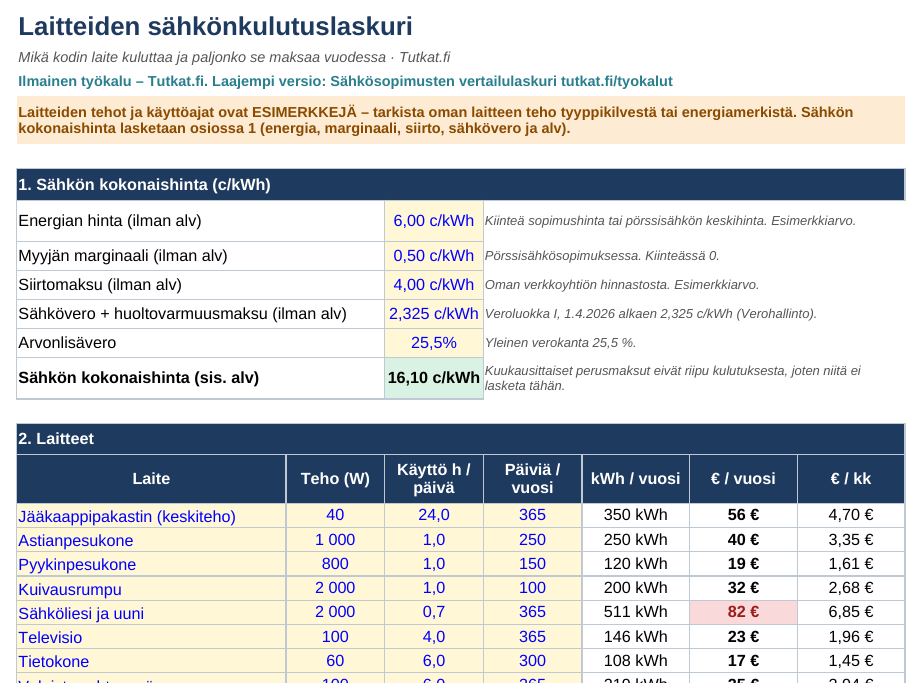
Appliance electricity consumption calculator
Calculate how much electricity household appliances use and how much they cost per year.
- Total price of electricity by component (incl. electricity tax and VAT)
- 15 editable equipment rows: kWh and € per year
- The three most expensive appliances highlighted
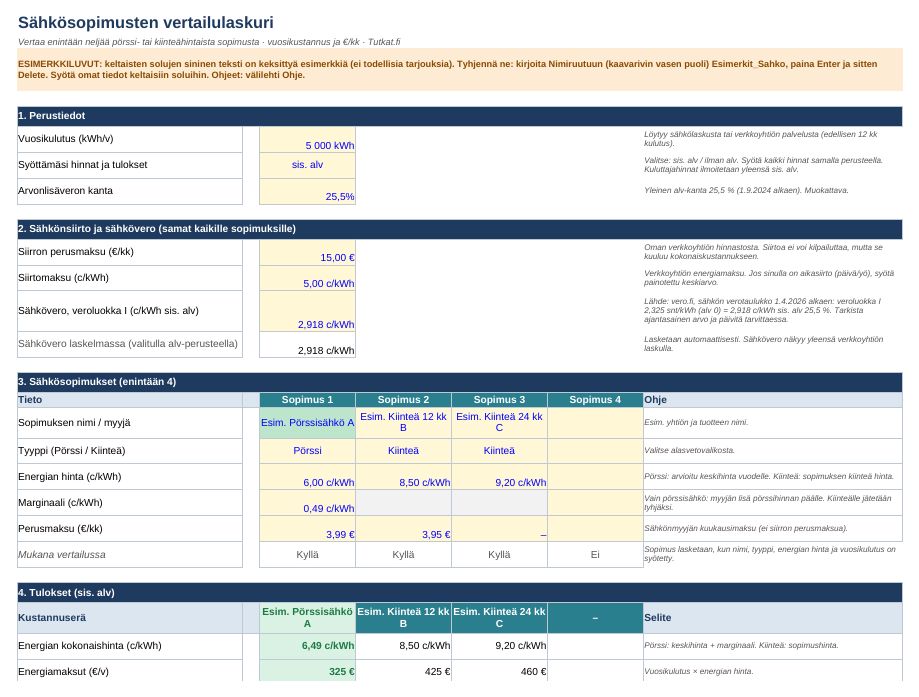
Electricity contract comparison calculator
Comparison of spot-price and fixed-price contracts using your own consumption.
Households
2,90 € incl. VATBuy 2,90 €Read before you decide
Spot electricity or a fixed price? How a spot-price contract works
How the spot electricity price is formed, how much it varies from month to month and when a fixed price may suit better. Figures 2025–2026.
Read the guide →Electricity transmission price: why transmission costs money and what an electricity bill consists of
An electricity bill consists of energy, transmission, electricity tax and VAT. See how big each part is, why transmission cannot be put out to tender and how to reduce your bill.
Read the guide →Electricity price in winter: why spot electricity gets more expensive and how to prepare
Why spot-price electricity gets more expensive in winter: consumption, wind power, maintenance and transmission links. Verified figures for winter 2025–2026 and ways to prepare.
Read the guide →How much does electricity cost per month? Detached house and block of flats 2026
Monthly electricity price in 2026 in an apartment building, a detached house and an electrically heated house: consumption figures, total price in c/kWh and bill examples.
Read the guide →Switching electricity contract: how to compare and switch electricity companies
How to switch electricity company: comparison on the sahkonhinta.fi service, two weeks' notice, the rules for fixed-term agreements and consumer rights.
Read the guide →Related topics on other radars
- Renovation price calculator: how much does a renovation cost? · Renovation Radar
- Housing calculator: what does a home cost in your area? · Housing Radar
- Buffer fund: how much savings should you have for a rainy day? · Money Radar
- Sauna calculator: electric heater consumption and heater size · Sauna Radar
- Household deduction for renovation 2026: how much you get and how to claim · Renovation Radar
Deadlines and dates
Electricity Price Radar reminds its subscribers of these by email.
- Winter time begins
Clocks go back an hour on the last Sunday of October. The day has 25 hours, which shows up in spot electricity prices and consumption metering as an extra hour.
Source - Grid service charges rise by 4%
Fingrid is raising main grid service charges by 4 percent from the start of 2027. The charges pass through the network companies into customers' transmission prices.
Source - Procurement of frequency-controlled reserves moves to the hourly market
Fingrid is centralising the procurement of frequency-controlled normal operation and disturbance reserve (FCR) on hourly markets and abandoning the yearly market. Applies to companies that sell demand response or their production to the reserve markets.
Source - Summer time begins
Clocks go forward an hour on the last Sunday of March, when the day has 23 hours.
Source
No upcoming dates right now.
Frequently asked questions: Electricity Price Radar
How much did spot-price electricity cost in September 2026?
The average spot electricity price in Finland in September 2026 was 5,70 c/kWh excluding VAT, or 7,15 c/kWh with 25,5 % VAT (Nord Pool). In August 2026 the average was 4,13 c/kWh (VAT 0). The seller's margin, transmission and electricity tax are added to the price.
How much is electricity tax in 2026?
The electricity tax for households (tax class I) is, from 1.4.2026, 2.325 c/kWh excluding VAT: energy tax 2.24 c/kWh and security of supply fee 0.085 c/kWh. With VAT it is about 2.92 c/kWh. Before 1.4.2026 the tax was 2.253 c/kWh.
How much electricity does a household consume per year?
In price statistics, a typical flat user consumes 2 000 kWh, a detached house with a sauna stove but no electric heating 5 000 kWh, and a detached house with direct electric heating 18 000 kWh a year. In Motiva's example, a 120 m² electrically heated detached house consumes 18 900 kWh and a 50 m² district-heated flat 3 100 kWh a year.
What does an electricity bill consist of?
An electricity bill consists of electrical energy (from the supplier), the network service or transmission (from the network company), electricity tax and 25,5 % VAT. According to the Energy Authority, the total price for a household using 5 000 kWh a year was on average 20,86 c/kWh on 1.11.2025, of which electrical energy was 9,45 c/kWh and transmission including tax 11,41 c/kWh.
Can I put electricity transmission out to tender?
You cannot. Electricity transmission is a natural monopoly, and the network company is determined by where you live. The Energy Authority supervises the reasonableness of network companies' pricing. You can freely tender your electricity seller, for example on the sahkonhinta.fi service.
Why does the spot electricity price change every 15 minutes?
The day-ahead electricity market moved to a 15-minute trading period in autumn 2025 (Fingrid). In a spot electricity contract the price can therefore change every quarter of an hour, and shifting consumption to cheaper periods reduces the bill.
How quickly can I switch my electricity contract?
The notice period for an open-ended electricity supply contract is always two weeks for a consumer (Energy Authority). A fixed-term contract is usually valid until the end of the agreed period. The seller must notify of a price increase in writing one month in advance.
How much does using a sauna with an electric heater cost?
An ordinary 6 kW electric sauna heater typically uses about 5–9 kWh for heating and bathing. When the total price of electricity is 20 c/kWh, one sauna session therefore costs about €1–2. With spot-price electricity, heating should be timed for the cheapest 15-minute periods.
Can a business deduct the VAT on electricity?
Yes. A VAT-liable business deducts the VAT on electricity used in its business, so a company should compare electricity contracts excluding VAT. Electricity tax and transmission charges are costs for a business too, and they cannot be put out to competitive tender in the same way as electricity energy.
What was the average spot electricity price in 2025?
According to Nord Pool, the average spot electricity price in the Finnish price area in 2025 was €40.48/MWh, i.e. 4.05 c/kWh excluding VAT (5.08 c/kWh with 25.5% VAT). In 2026 monthly averages have ranged from 1.54 c/kWh in July to 13.72 c/kWh in February.
Will there be enough electricity in winter 2026–2027?
According to the assessment published by Fingrid on 24.9.2026, electricity is expected to be sufficient if the large power plants and the transmission links to Sweden and Estonia work normally. On a very cold and calm day, consumption may rise to about 15 200 megawatts, while domestic production is sufficient for at most about 12 000 megawatts; the rest is imported.
What is electricity tax class II and who pays it?
From 1.4.2026, the electricity tax for tax class II is 0,135 c/kWh (VAT 0), while the tax for class I is 2,325 c/kWh. The lower tax class applies, among other things, to electricity used in industry and professional greenhouse cultivation. Check the right to it and the procedure in the Finnish Tax Administration's guidance on electricity tax.
How to use the information
- If you have a spot-price electricity contract, schedule the biggest consumption – the water heater, electric car charging, laundry and dishwashing – for the cheapest periods. The spot price changes every 15 minutes, and next-day prices are published the day before.
- Check your own annual consumption in Oma Datahub before comparing contracts. Enter your own consumption on the sahkonhinta.fi service and compare both the energy charge (c/kWh) and the basic fee (€/month) – with low consumption the share of the basic fee is emphasised.
- As a consumer, you can terminate an open-ended electricity contract with two weeks' notice. The seller must notify of a price increase in writing one month before it takes effect.
- Distribution and electricity tax cannot be put out to competition: the network company is determined by where you live. For a household, distribution and taxes accounted for over half of the total price on 1.11.2025 (11,41 / 20,86 c/kWh), so savings are worth seeking by reducing consumption too.
- Be prepared for winter: the monthly average price of spot-price electricity was 11,73 c/kWh in January 2026 and 13,72 c/kWh in February (VAT 0), compared with 1,54 c/kWh in July 2026. Compare contract types according to your own risk tolerance.
- Spot-price variation is greatest in winter: in 2026 the average prices for January and February were 11,73 and 13,72 c/kWh, while the average for the whole of 2025 was 4,05 c/kWh (VAT 0). If you cannot be flexible with your consumption, consider a fixed price before winter.
- Compare the company's electricity contracts excluding VAT and check whether your operations fall into electricity tax class II (0,135 c/kWh). The difference between tax classes I and II is about 2,19 c/kWh, which is a significant sum at high consumption.
- If your business has flexible consumption (e.g. cold stores, heat pumps, charging), find out from your electricity supplier or aggregator about reserve market opportunities. Fingrid's procurement of FCR reserves moves to hourly markets on 1.1.2027.
- Consumer and business transmission prices may rise in 2027, as Fingrid is raising its transmission grid service charges by 4 % from the beginning of the year. Check your own network company's pricing and notices.
Useful links
Get the Electricity Price Radar digest by email
Every Monday or once a month: the most important figures and the next deadlines. Free of charge, and you can cancel at any time.
Related radars
Sources (18)
- Nord Pool: Day-ahead aggregate prices, FI, 2026 (API)
- Nord Pool: Day-ahead aggregate prices, FI, 2025 (API)
- Nord Pool: Day-ahead prices, Finland
- Finnish Tax Administration: Electricity tax tables
- Finnish Tax Administration: General VAT rate rises in September (2024)
- Statistics Finland: Energy prices June 2026 (24.9.2026)
- Energy Authority: Households' electricity bill fell by two percent – renewing the contract paid off in 2025 (15.1.2026)
- Statistics Finland: Typical electricity consumers (StatFin, energy prices)
- Motiva: You decide – what kind of electricity user are you (2024)
- Motiva: Home electricity use, electricity contracts and controlling consumption
- Energy Authority: FAQ on electricity network service charges
- Energy Authority: Consumer information for electricity customers
- Fingrid: The day-ahead electricity market has moved to a 15-minute trading period (2025)
- Fingrid: Datahub customer portal
- Directive 2000/84/EC on summer-time arrangements (EUR-Lex)
- Finnish Tax Administration: Electricity tax tables (tax classes I and II, updated 23.3.2026)
- Fingrid / STT Info: Electricity is expected to be sufficient in winter (24.9.2026)
- Fingrid / STT Info: Procurement of frequency-controlled normal operation and disturbance reserve to be centralised on hourly markets in 2027 (8.9.2026)
The information has been compiled from public sources on 6.10.2026. Always check the current terms from the original source. The information is not investment, loan or legal advice.