Check the wind in good time!
The Finnish Meteorological Institute's wind warnings for land areas are based on gusts, and the limits tighten for the winter season from 1.11.2026: a yellow warning is issued for gusts of 20 m/s (in summer 15 m/s). For work machines, the most important figure is the manufacturer's wind limit – the limit for a mobile elevating work platform intended for outdoor use is typically 12,5 m/s. Wind power produced as much as 26,1 % of Finland's electricity in 2025. For event organisers: the minimum weights of pop-up tents are dimensioned for wind of up to 15 m/s, and a public event of at least 200 people requires a rescue plan.
Wind Radar tells you the wind warning limits on land and at sea, converts wind units and checks whether the wind limit of a hoist, tent or stage is sufficient.
- Sailors, surfers, fishers, drone pilots and outdoor enthusiasts
- Lifting work, aerial work platforms, scaffolding and roofing work
- Festivals, concerts and markets: tents, stages and wind limits
What is the wind now and tomorrow?
Observation and 36-hour forecast from the Finnish Meteorological Institute. Set your own wind limit to see when it is exceeded.
Example limits: · · . The limit of the machine or structure itself is what counts.
mean wind gust your wind limit
Forecast as a table
| Time | Wind m/s | Gust m/s | Direction |
|---|
Source: Finnish Meteorological Institute open data (CC BY 4.0). Official warnings: ilmatieteenlaitos.fi/varoitukset.
Calculator
Calculator
Calculator
Calculators on their own pages: Wind converter · Wind at working height · Will the event structure withstand the wind? Wind calculator for organisers · All calculators
Wind Radar in numbers
The Beaufort scale and the Finnish Meteorological Institute's verbal wind descriptions
Wind strength as a 10-minute average at a height of about 10 metres in open terrain. The Finnish Meteorological Institute's verbal expressions (calm 0, light 1–3, moderate 4–7, fresh 8–13, strong 14–20, storm 21–32, hurricane at least 33 m/s) correspond approximately to the Beaufort classes. Gusts can be 1.5–2 times the mean wind.
| Beaufort | Finnish Meteorological Institute attribution | m/s | km/h | Solmua | What it looks like in the countryside |
|---|---|---|---|---|---|
| 0 | Calm | 0–0,2 | under 1 | under 1 | Smoke rises straight up. |
| 1 | Light wind | 0,3–1,5 | 1–5 | 1–3 | Smoke shows the wind direction. |
| 2 | Light wind | 1,6–3,3 | 6–11 | 4–6 | You feel the wind on your face, leaves rustle. |
| 3 | Moderate wind | 3,4–5,4 | 12–19 | 7–10 | Flags begin to flutter, and leaves and branches move constantly. |
| 4 | Moderate wind | 5,5–7,9 | 20–28 | 11–16 | Dust and paper are raised, small branches move. |
| 5 | Brisk wind | 8,0–10,7 | 29–38 | 17–21 | Small deciduous trees begin to sway. |
| 6 | Brisk wind | 10,8–13,8 | 39–49 | 22–27 | Big branches move, wires whistle. |
| 7 | Strong wind | 13,9–17,1 | 50–61 | 28–33 | Whole trees sway, it is hard to walk against the wind. |
| 8 | Strong wind | 17,2–20,7 | 62–74 | 34–40 | Walking into a headwind becomes clearly difficult. |
| 9 | Storm | 20,8–24,4 | 75–88 | 41–47 | Minor structural damage (chimneys, roof tiles). |
| 10 | Storm | 24,5–28,4 | 89–102 | 48–55 | Trees are uprooted, considerable damage to buildings. |
| 11 | Storm | 28,5–32,6 | 103–117 | 56–63 | Very rare; extensive damage to buildings and trees. |
| 12 | Hurricane-force wind | at least 32,7 | at least 118 | at least 64 | Very rare on land; great destruction. |
Finnish Meteorological Institute wind warnings for land and sea
Warnings for land areas are based on wind gusts, and the limits depend on the season. Warnings for sea areas are based on the 10-minute mean wind. Warnings are issued for up to the next five days. Thunderstorm gusts are warned about separately with the severe thunderstorm warning. Situation on 6.10.2026.
| Area and warning | Level | Limit |
|---|---|---|
| Land areas, winter season 1.11.–30.4. | Yellow | gusts 20 m/s |
| Land areas, winter season 1.11.–30.4. | Orange | gusts 25 m/s |
| Land areas, winter season 1.11.–30.4. | Red | gusts 30 m/s |
| Land areas, summer season 1.5.–31.10. | Yellow | gusts 15 m/s |
| Land areas, summer season 1.5.–31.10. | Orange | gusts 20 m/s |
| Land areas, summer season 1.5.–31.10. | Red | gusts 25 m/s |
| Sea areas: notice to boaters (only 1.5.–31.10.) | Yellow | mean wind 11–13 m/s |
| Sea areas: strong wind warning | Yellow | mean wind 14–20 m/s |
| Sea areas: storm warning | Orange | mean wind 21–32 m/s |
| Sea areas: hurricane warning | Red | mean wind at least 33 m/s |
Minimum weights per leg for a small tent
The rescue sector's guidance on loose weights. Applies to tarpaulin-roofed tents in wind of up to 15 m/s. The manufacturer's or a qualified designer's instructions take precedence. The total weight is calculated for four corners.
| Tent size | Weight per foot | Total (4 corners) |
|---|---|---|
| 2 × 2 m | 15 kg | 60 kg |
| 4 × 4 m | 62 kg | 248 kg |
| 5 × 5 m | 96 kg | 384 kg |
| 6 × 6 m | 139 kg | 556 kg |
Recreational craft design categories and wind
The design category of a CE-marked pleasure craft tells what kind of wind and wave conditions the boat is designed for. The category can be found on the manufacturer's plate and in the owner's manual. Metres per second have been converted from the Beaufort scale. Note that sea-area forecasts and warnings are based on the 10-minute mean wind, and gusts are stronger.
| Class | Wind up to | Answer m/s | Significant wave height at most |
|---|---|---|---|
| A | over Beaufort 8 | over 20,7 m/s | over 4 m |
| B | Beaufort 8 | up to 20,7 m/s | 4 m |
| C | Beaufort 6 | up to 13,8 m/s | 2 m |
| D | Beaufort 4 | up to 7,9 m/s | 0,3 m |
Source: Recreational Craft Directive 2013/53/EU, Annex I A.1; Beaufort conversion: MeteoSwiss
Save time with ready-made templates
Free tool available to download with a free account. Larger tools as a one-off purchase, no subscription: files immediately after payment.
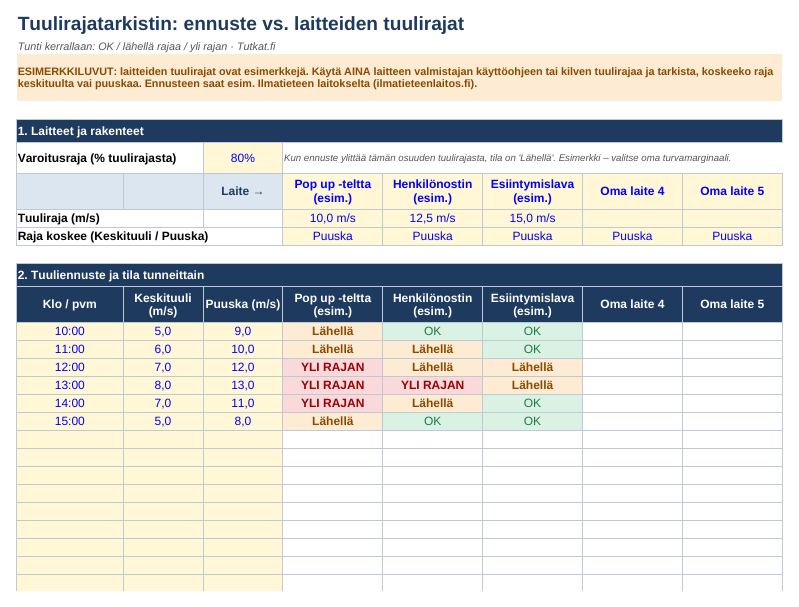 Free tool
Wind limit checker
Compare the hourly wind forecast with the wind limits of tents, lifts and stages.
- Five devices, each with its own wind limits
- OK / Close / OVER THE LIMIT hourly for 24 hours
- Own warning limit and mean wind / gust selection
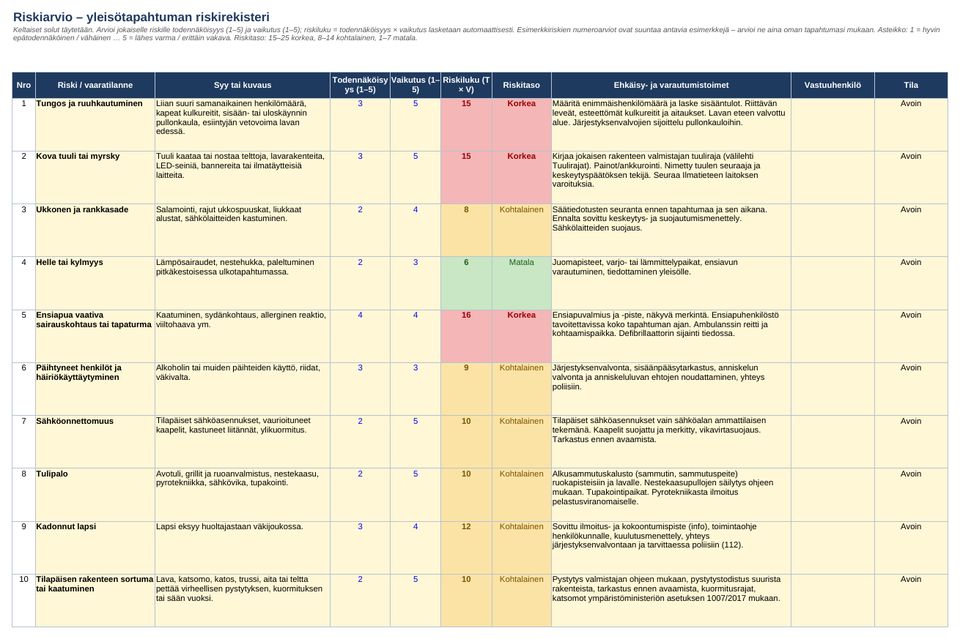
Event safety package
Rescue plan template, risk assessment and permit checklist.
Event organisers, associations, venues
19,90 € + VAT 25,5 % = 24,97 €Buy 19,90 € + VATEntrepreneur Package: all 10 tools €29 + VAT (separately €109 + VAT) →
Read before you decide
Wind limit for a tent, hoist and drone – how much is too much?
The weights of a pop-up tent are sized for a 15 m/s wind, and the limit for a personnel lift is typically 12.5 m/s. See how to read the wind limit correctly.
Read the guide →The Beaufort scale and storm warnings in plain language
What do Beaufort 6 or gusts of 20 m/s mean in practice? How to read wind strength and Finnish Meteorological Institute warnings, and prepare for a storm.
Read the guide →Related topics on other radars
- Flight compensation calculator: compensation for a delayed or cancelled flight · Travel Radar
- Cottage calculator: what does a lakeside cottage cost to buy and keep? · Cottage Radar
- Recreation day calculator: how much does a recreation day cost? · Activity Radar
- Party calculator: budget and catering quantities · Venue Radar
- Flight delayed or cancelled: compensation under EU Regulation 261/2004 · Travel Radar
Deadlines and dates
Wind Radar reminds its subscribers of these by email.
- Last day for wind notices to boaters
The yellow notice to boaters for sea areas (mean wind 11–13 m/s) is only issued during the summer season 1.5.–31.10.
Source - Wind warnings for land areas switch to winter limits
In the winter season 1.11.–30.4., a yellow wind warning is issued for gusts of 20 m/s, orange for 25 m/s and red for 30 m/s (in summer 15, 20 and 25 m/s).
Source - Vene 27 Båt boat show begins
Helsinki International Boat Show at Messukeskus 12.–21.2.2027; the sustainability partner is the Finnish Swimming Teaching and Lifesaving Federation.
Source - Wind warnings for land areas switch to summer limits
In the summer season 1.5.–31.10., a yellow wind warning is already issued for gusts of 15 m/s, and notices to boaters are again issued for sea areas at a mean wind of 11–13 m/s.
Source
No upcoming dates right now.
Frequently asked questions: Wind Radar
What is the difference between average wind and a gust?
Mean wind is the 10-minute average of wind speed. A gust is an instantaneous wind of 5–10 seconds, which according to the Finnish Meteorological Institute is usually about 1.5 times and at most about 2 times the mean wind. On land, wind warnings are based on gusts, at sea on the mean wind.
When does the Finnish Meteorological Institute issue a wind warning?
In land areas in the winter season 1.11.–30.4., a yellow warning is issued for gusts of 20 m/s, orange for 25 m/s and red for 30 m/s. In the summer season 1.5.–31.10. the limits are 15, 20 and 25 m/s. At sea, a gale warning is issued for a mean wind of 14–20 m/s, a storm warning for 21–32 m/s and a hurricane warning for at least 33 m/s.
In how strong a wind may a drone be flown?
The law sets no single m/s limit. According to Traficom, the manufacturer has stated a maximum recommended wind speed for every commercial drone, and it must be followed. Note that wind is usually stronger at altitude, a payload can reduce the drone's wind tolerance, and when returning against the wind the ground speed drops and the battery drains faster.
Where can I get wind observations free of charge for my own use?
The Finnish Meteorological Institute's Download observations service lets you download weather observations into a spreadsheet without programming, and the open data interface provides machine-readable data. The open data is under the CC BY 4.0 licence, meaning it may also be used commercially when the Finnish Meteorological Institute is credited as the source. The Finnish Meteorological Institute's observation station network includes about 400 stations of different types; the station list is available at ilmatieteenlaitos.fi/havaintoasemat.
In what wind may you work with a personnel lift?
The wind limit marked on the machine by the manufacturer decides. Under the EN 280 standard, the limit for a mobile elevating work platform designed for outdoor use is typically 12,5 m/s, and the limit for a platform intended only for indoor use is 0 m/s. At a height of 20 metres the wind can be up to 50 % stronger than on the ground, so also check the wind at working height. Large boards and fabrics in the basket act as a sail.
What is the wind limit for a crane or tower crane?
There is no common figure: the limit is crane-specific and can be found in the manufacturer's operating instructions and load diagram. According to the Centre for Occupational Safety's guide Nosta turvallisesti (2024), wind and rain are taken into account when planning a lift, and the limit values are checked from the crane's instructions. A large, light load may restrict lifting in wind that is well below the crane's limit.
What do you need to know about a tent's wind resistance at an outdoor event?
Temporary tents over 50 m² are subject to standard SFS-EN 13782:2015, which covers the design, erection and maintenance of tents. The maximum permitted wind for a tent comes from the manufacturer's or structural plan's documents. Record the limit in the event's safety plan and decide in advance who monitors the wind and at what wind speed the tent is evacuated.
How much of Finland's electricity is generated by wind power?
In 2025 wind power produced 22.1 TWh, or 26.1% of Finland's electricity generation (Finnish Energy). Capacity on 30.6.2026 totalled 9,535 MW with 2,013 turbines (Suomen Uusiutuvat). According to Fingrid, the highest wind power output in winter 2025–2026 was 6,998 MW as a quarter-hour average.
When does an outdoor event need a rescue plan, and by when must it be submitted?
A rescue plan for a public event must be drawn up when at least 200 people are expected to be present at the same time, when open flames, fireworks or other pyrotechnic products or special effects are used, when the evacuation arrangements differ from the usual, or when the nature of the event causes particular personal safety risks (Government Decree 407/2011, section 3). The plan is submitted for information to the rescue authority of your own area at least 14 days before the start of the event (Rescue Act 379/2011, section 16). A plan submitted later is acceptable only if the rescue authority accepts it for a special reason.
What must a rescue plan contain, and does wind have to be addressed in it?
According to section 16 of the Rescue Act, the plan must include an account and assessment of the hazards and risks of the event, and the safety arrangements and instructions defined on that basis. The Act does not name wind separately, so weather risks belong in the plan when they are real hazards of the event, such as at an outdoor event with tents, stages or inflatable equipment. According to the rescue services' guide, the plan also records the name and contact details of the person responsible for the event's safety.
How much weight is needed on the legs of a pop-up tent?
According to the rescue sector's guidance, when loose weights are used, each corner must have at least: for a 2 × 2 m tent 15 kg, for a 4 × 4 m tent 62 kg, for a 5 × 5 m tent 96 kg and for a 6 × 6 m tent 139 kg per leg. The weights apply to tarpaulin-roofed tents in wind of up to 15 m/s. The tent is fastened to ground anchors or weights with lines whose tensile strength is at least 1 000 kg. If the manufacturer has given other instructions, they are followed. According to Tukes, counterweights do not necessarily prevent the tent from sliding sideways, so sideways movement is prevented with stakes or additional weights.
What is the wind limit for a stage, roof structure or LED wall?
There is no single general figure. The limit comes from the structure manufacturer's or structural designer's documents, and the rescue authority requires that the wind and weight limits of stage structures are known and observed. For large or exceptional structures an erection certificate is drawn up. Grandstands are built in accordance with the Ministry of the Environment's usage safety decree 1007/2017. Tents over 50 m² have their own standard, SFS-EN 13782:2015, and aluminium and steel trusses (trusses) SFS-EN 17115:2018.
In what wind must use of a bouncy castle be stopped?
According to Tukes, use of a bouncy castle is always interrupted when the wind limit is exceeded, and weather conditions are monitored throughout use. The limit comes from the equipment manufacturer's instructions; in Finland there is no single m/s figure set by the authorities. The castle must have at least six anchor points, each of which must withstand a force of 160 kg, and the supervisor must be able to intervene, for example in strong gusts of wind. The equipment is covered by standard SFS-EN 14960-1:2019. Serious accidents and near misses are reported to Tukes.
In what wind can you go out in a small boat?
There is no single statutory limit. The starting point is the boat's design category: a category D boat is designed for winds of up to Beaufort 4 (about 5.5–7.9 m/s) and a significant wave height of 0.3 metres, and a category C boat for winds of up to Beaufort 6 (up to 13.8 m/s) and waves of 2 metres (Recreational Craft Directive 2013/53/EU). In the summer season, 1 May–31 Oct, the Finnish Meteorological Institute issues a notice to boaters for sea areas already at a mean wind of 11–13 m/s.
May you fell trees in the forest in windy weather?
The law sets no m/s limit, but according to Tapio's occupational safety guide (2024), tree felling should be avoided in strong and especially gusty wind, because controlled felling becomes harder. When the Finnish Meteorological Institute has issued a gust warning, work at hazardous sites, such as trees at the edge of an open area, is best postponed. The safety distance in felling is two tree lengths.
Is it enough for a lifting operation that no wind warning is in force?
No. A yellow wind warning for land areas is issued only for gusts of 20 m/s in the winter season 1.11.–30.4. and 15 m/s in the summer season, whereas the wind limit of a personnel lift intended for outdoor use is typically 12.5 m/s. In addition, the wind is stronger at working height than on the ground. Therefore always compare the forecast gusts with the machine's own wind limit and measure the wind on site.
How to use the information
- In a forecast, always look at both the mean wind and the gusts. Gusts are typically about 1.5 times, and at most about 2 times, the mean wind – the limit for work machinery and drones often concerns precisely the momentary wind.
- Fly a drone only below the maximum wind speed stated by the manufacturer. Set off into a headwind so that the return is made with a tailwind: the automatic return function does not take the wind into account, and in a headwind the battery drains quickly.
- Check the boat's design category on the manufacturer's plate before setting out. A category D boat is designed for winds of up to Beaufort 4, i.e. about 8 m/s, and a category C boat for winds of up to Beaufort 6, i.e. about 14 m/s. In the summer season the Finnish Meteorological Institute issues a notice to boaters already at a mean wind of 11–13 m/s.
- Sailor, surfer or kitesurfer: in addition to the forecast, look at the latest observations from the nearest coastal observation station. The Finnish Meteorological Institute has about 400 observation stations, and warnings for sea areas are based on the mean wind, so gusts are stronger than forecast.
- Note that the limits for wind warnings over land rise on 1.11.: in winter a yellow warning is issued only for gusts of 20 m/s. The absence of a yellow warning therefore does not mean the wind is suitable for lifting work or event structures.
- Check the manufacturer's wind limit on the aerial work platform's sign before lifting. The limit for a platform intended for outdoor use is typically 12,5 m/s, and a platform intended for indoor use only must not be used in wind at all. Measure the wind at working height, not on the ground. Wind strengthens with height – according to IPAF, at a height of 20 metres it can be up to 50 % stronger than at ground level.
- Scaffolding sheeting increases the wind load. Sheeted scaffolding needs closer anchoring than unsheeted – according to the Centre for Occupational Safety, with large wind loads as often as every 2 metres.
- Forestry work: avoid felling trees in strong and especially gusty wind, and postpone work at hazardous sites when a gust warning is in force. Keep others at least two tree lengths away (Tapio 2024).
- For tents, stages and inflatable equipment at an outdoor event, make a wind plan in advance and record it in the rescue plan: the manufacturer's wind limit for each structure, a person who monitors the wind and decides on stopping use, and the wind speed at which a structure is deflated or dismantled. For large or exceptional structures, prepare an erection certificate (Rescue Services).
- Monitor conditions in two ways: in advance through weather forecasts and on site in real time throughout the event. Close or take down tents in anticipation, not only when the wind already requires it (Tukes, guidance of 7.4.2025). Subscribe to the Finnish Meteorological Institute's warnings for the event area. On land, gusts are warned about, and thunderstorm gusts get a separate severe thunderstorm warning (yellow over 15 m/s, orange over 25 m/s, red over 30 m/s). No warnings are yet issued for lightning.
- Secure every leg of a tent with weights or ground stakes regardless of the weather. Wind getting under the roof lifts the tent and wind hitting the walls pushes it sideways, so wall panels increase the weight needed (Tukes).
- Inspect vendors' and exhibitors' tents before the area is opened to the public, and share the anchoring instructions with everyone in advance. According to Tukes, the organiser is responsible for instructing and supervising the tents at their event.
Useful links
Get the Wind Radar digest by email
Every Monday or once a month: the most important figures and the next deadlines. Free of charge, and you can cancel at any time.
Related radars
Sources (43)
- Finnish Meteorological Institute: Wind warnings
- Ilmatieteen laitos: Wind warnings for land and sea
- Finnish Meteorological Institute: Winds
- Ilmatieteen laitos: Sea records
- Ilmatieteen laitos: Weather records in Finland
- Ilmatieteen laitos: Aapeli storm marked the beginning of a cold January
- Yle: Hurricane-force wind recorded in Finland for the first time (2.11.2024)
- Finnish Meteorological Institute: Open data
- Ilmatieteen laitos: Open data licence (CC BY 4.0)
- Finnish Meteorological Institute: Downloading observations
- MeteoSwiss: Beaufort table
- Finnish Energy: Electricity year 2025
- Finnish Energy: Energy statistics 2025 (21.1.2026)
- Finnish Renewables Association: Wind power annual statistics 2025
- Finnish Renewables Association: Wind power annual statistics 30.6.2026
- Fingrid: Operation of the power system in winter 2025–2026 (30.3.2026)
- Fingrid: Financial statements release 2025
- IPAF: In what wind speed can a MEWP work?
- IPAF: Wind Rating Guidance
- SFS: SFS-EN 280-1:2022 Mobile elevating work platforms
- SFS: SFS-EN 13782:2015 Temporary structures. Tents. Safety
- Traficom: How weather affects flying
- Centre for Occupational Safety: Lift safely (2024)
- Centre for Occupational Safety: Safely on scaffolding
- Occupational Safety and Health Administration: Safe use of vehicle cranes at public events
- STT Info: Responsibility partner of the Vene 27 Båt boat show (24.9.2026)
- Finlex: Rescue Act 379/2011
- Finlex: Act amending the Rescue Act 616/2022 (section 16)
- Finlex: Government Decree on rescue services 407/2011
- City of Helsinki: Event notifications and permits
- Pelastustoimi: Temporary structures (tilapäiset rakenteet)
- Rescue services: Guide to drawing up a rescue plan for a small public event
- Tukes: Lightweight, quick-erect and pop-up tents used at events (guidance 7.4.2025)
- Tukes: Make sure the bouncy castle is secured (7.6.2023)
- Tukes: Safe use of bouncy castles requires supervision (2.8.2019)
- Finnish Meteorological Institute: Warnings of severe thunderstorms
- Finnish Meteorological Institute: Information about warnings
- EVS: EN 13782:2015 Temporary structures – Tents – Safety (scope over 50 m²)
- SFS: SFS-EN 17115:2018 Entertainment technology – aluminium and steel trusses
- EUR-Lex: Directive 2013/53/EU on recreational craft and personal watercraft, Annex I
- PRS: Design categories of recreational craft (2024)
- Tapio: Occupational safety in DIY forestry work (2024)
- Finnish Meteorological Institute: Observation stations
The information has been compiled from public sources on 6.10.2026. Always check the current terms from the original source. The information is not investment, loan or legal advice.